As an Amazon Associate, we earn from qualifying purchases. Some links on this site are affiliate links at no extra cost to you. Our recommendations are based on thorough research and editorial judgment.

Lens Compression Explained: What It Is (and Why It’s Mostly Perspective)

Lens compression is a photography effect mainly achieved with telephoto lenses. It visually alters the perceived distance between subjects and backgrounds due to perspective principles. When we use a telephoto lens, we can make the background appear closer and more significant. This effect is most prominent when the background is at least twice as far from the camera as the subject. Understanding lens compression helps us create stunning images and enhances our photographic techniques, leading to exciting discoveries ahead.
Key Takeaways
- Lens compression occurs with telephoto lenses, making the background appear closer to the foreground due to altered perspective.
- The effect is amplified when the background is at least double the distance from the camera as the subject.
- Perspective distortion happens when objects change size based on their distance to the camera, influencing the overall composition.
- Telephoto lenses excel at isolating subjects by minimizing distractions and enhancing depth within the frame.
- Understanding and manipulating distances can enhance photographic storytelling, providing unique perspectives even in familiar scenes.
What Is Lens Compression?
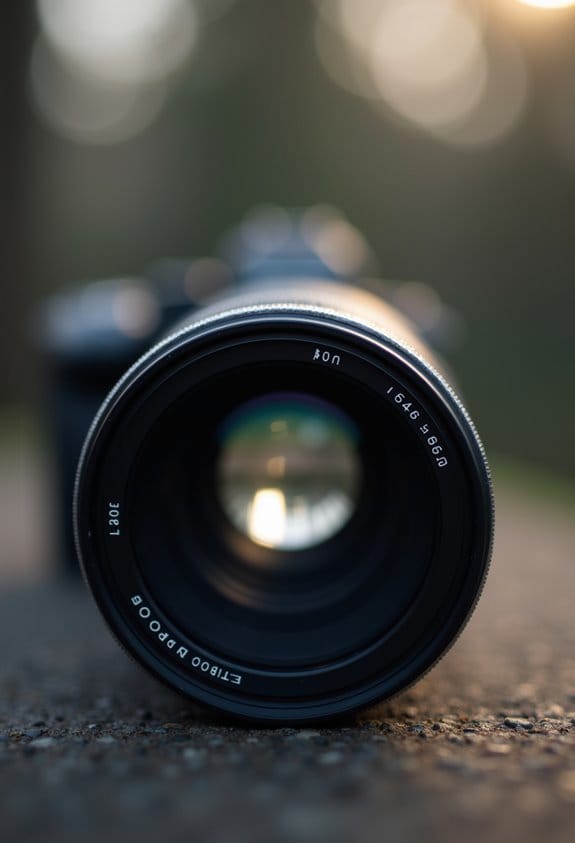
Lens compression is such a fascinating concept in photography, and it’s one that can really transform how you see your images! Essentially, lens compression happens mostly when you use telephoto lenses, which make the background appear much closer to the foreground. So, when you zoom in on your subject, say a person standing against a mountainscape, those mountains may seem almost right behind them rather than far away.
The cool thing about lens compression is that it’s all about relative distance. It’s less about the zoom of the lens itself and more about how far away your camera is from your subject compared to that background. For example, if you shoot a portrait with a longer lens from a distance, you can make the background look really close, which helps highlight your subject and minimize distractions. Just think about taking photos of wildlife; using a telephoto lens allows you to capture those animals up close while blurring out the forest behind them, creating a more focused and captivating image.
Understanding lens compression not only helps you control how your images look but can also elevate your storytelling in photography. It’s all about bringing your audience’s attention exactly where you want it. So the next time you’re out shooting, play around with different lenses and distances—you might be surprised by the stunning effects you can create! Additionally, lenses with optical image stabilization can help maintain sharpness during handheld telephoto shots, enhancing the quality of compressed perspective images.
The Science Behind Lens Compression

Hey there! So, let’s chat about the science behind lens compression. This cool effect happens mainly when you’re using telephoto lenses, and it’s all about the distances between your camera, the subject, and the background. When you zoom in with a telephoto lens, the background can look closer and larger compared to your subject, which can really change the vibe of your shot.
For example, if you’re shooting a portrait of a friend with a mountain behind them, a telephoto lens will make that mountain appear much bigger—almost as if it’s looming. But to achieve that impressive effect, the distance from the subject to the background needs to be at least twice that of the distance from the camera to the subject. It’s like stacking the distances to create that striking look!
And here’s something important: even though a longer focal length enhances lens compression, remember that it’s really about how far you’re viewing the scene, not just the lens itself. Let’s explore more about how different focal lengths can affect your images, and how to make the most of them!
Also, when selecting lenses for such effects, considering the sensor size of your camera can significantly influence the image’s overall quality and depth.
Understanding Perspective Distortion

So, let’s chat about perspective distortion in photography. It really plays a huge role in how your images turn out! Perspective distortion happens when you change how far you are from your subject. This distance can make objects look larger or smaller than they actually are, which can totally mess with how we perceive the relationships between things in your frame.
For example, when you shoot with a wide-angle lens and get super close to a subject—a flower, for instance—that flower can seem enormous compared to everything else around it. Meanwhile, the background might look much closer than it really is, altering the scene’s depth. To get things looking just right, you’ll want to experiment with how far back you stand from your subject. This can really make a difference, especially if you’re photographing a group of people or a busy street scene.
Understanding perspective distortion can genuinely elevate your photography skills. It gives you the power to compose your shots with intention, ensuring that everything is in harmony. Up next, let’s explore how to use these principles creatively in your compositions! Keep in mind that choosing the right lens types can also help you manage perspective and enhance your travel photography.
How to Achieve Lens Compression in Photography
Hey! So, let’s talk about achieving lens compression in photography. It’s such a cool technique that can really change how we perceive depth in our images. To start, using a telephoto lens with a focal length between 135-200mm is key. Think of it this way—when you zoom in on your subject, you want to make sure you’re standing a good distance away from them, which helps create that gorgeous compression effect.
Here’s a little tip: try to keep the background at least twice as far from your subject as you are. So, if you’re 10 feet away from the subject, aim for the background to be about 20 feet back. This distance makes the background appear closer to your subject, enhancing the effect even more. Oh, and don’t be afraid to experiment! You can step back while zooming in, which can help you frame your subject in a way that emphasizes depth and removes any distracting elements. Adding controlled lighting using a wireless flash can further enhance the subject and background separation for dramatic results.
Practical Applications of Lens Compression
Have you ever heard of lens compression? It’s a fascinating concept that can really improve your photography skills! With a telephoto lens, for example, you can beautifully isolate your subject from the background. Imagine you’re at a busy park and want to capture a striking portrait of a person. By using this type of lens, you can stand back and remove all that distracting detail behind them, making your subject pop right off the frame.
Now, if you’re into landscape photography, lens compression can work wonders too. Picture this: you’re at a stunning location and notice a lovely flower in the foreground. If you use a wide-angle lens and get close to that flower, you can make distant mountains appear massive in comparison. This creates a sense of depth that draws the viewer into the scene. Just remember, for the best results with lens compression, keep your background at least double the distance away from your subject compared to where you’re standing. Using a camera with a flip screen can greatly assist in composing such creative shots from various angles.
Real-World Examples of Lens Compression Effects
You know, when we talk about lens compression, it’s really fascinating to see how it applies in the real world, especially in photography. For example, if you pick up a 200mm telephoto lens, it can make distant mountains look huge and really close in your shots, even if they’re miles away. Just think about it: you can have a person standing just a few feet in front of you, while that backdrop of mountains looms larger than life in the background.
As you play around with different distances from your subject, you’ll notice how the way the background interacts with your subject changes. Using something like a 300mm lens can take this to another level. It allows you to capture stunning details from afar and minimizes the sense of separation between what’s in the foreground and what’s in the background. It’s particularly great for portraits because you can really highlight your subject without a distracting background. Many mirrorless cameras, like the Canon EOS R100 Double Zoom Lens Kit, come equipped with telephoto lenses that enable photographers to explore the creative potential of versatile zoom ranges.
Frequently Asked Questions
Does Lens Compression Affect Video Recordings the Same Way as Photos?
Yes, lens compression affects video recordings just like photos. Depending on focal length, it influences video framing, depth perception, and shot composition, enhancing storytelling techniques and audience perception through cinematic effects and intentional lens selection for visual style.
Can Lens Compression Enhance or Detract From Artistic Expression?
Absolutely, lens compression can dramatically enhance our artistic vision. It influences creative framing and emotional impact, shaping spatial relationships, isolating subjects, and enriching visual storytelling, all while promoting engaging compositions and deeper narrative enhancement.
What Types of Lenses Are Best to Avoid Lens Compression?
To avoid lens compression, we should use wide angle lenses for depth perception and framing, while being mindful of telephoto lenses’ impact on background separation. Prime lenses often provide better distortion control than zooms, depending on focal length.
How Can Understanding Lens Compression Improve Portrait Photography?
Understanding lens compression enhances our portrait photography by allowing us to manipulate subject positioning, background separation, and framing techniques. This creates emotional impact, improves depth perception, and aids in visual storytelling while following composition rules and lighting effects.
Are There Software Tools to Simulate Lens Compression Effects?
Yes, there are various tools like lens simulation software and photographic editing software that help us simulate lens compression effects. We can also explore 3D rendering tools and augmented reality filters for more creative options.